
If you’ve ever walked past MSC’s Amusement Area and heard a mix of arcade sound effects, overly competitive teenagers, and someone shouting “I SPUN OUT AGAIN!”, you’ve found MSC’s digital playground.
This is the part of the ship where MSC leans into paid, high-tech fun – racing rigs, VR experiences, and interactive cinemas that feel closer to a theme park arcade than a traditional cruise activity deck. And it’s also where budgeting matters, because most of these experiences are not included in your cruise fare.
What kinds of “VR and simulators” does MSC offer?
MSC’s lineup varies by ship, but the experiences usually fall into four buckets:
Racing simulators (the headline attraction)
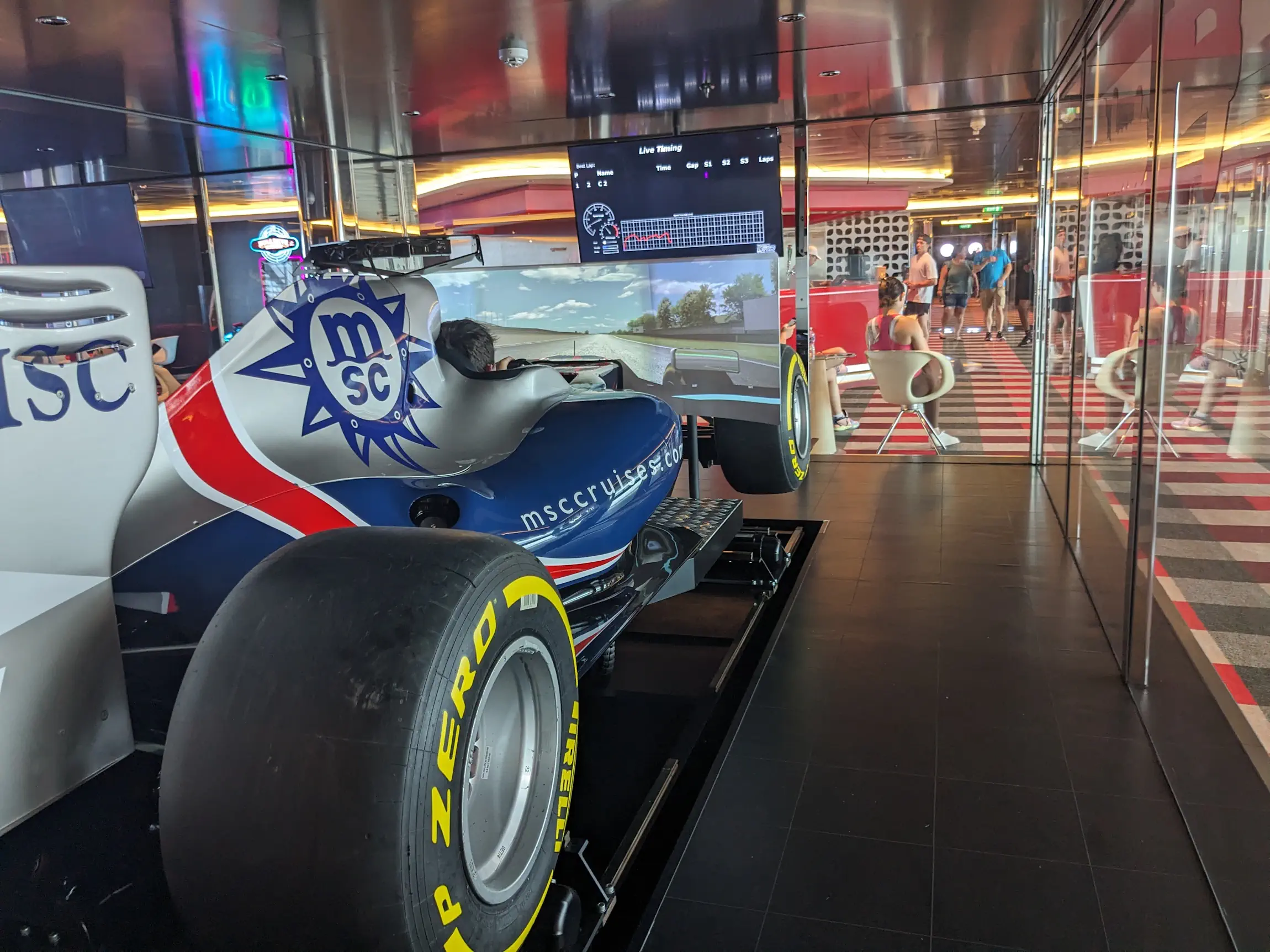
MSC’s most recognizable simulator is the MSC Formula Racer, often described onboard as an F1-style racing simulator. On ships that have it, it’s typically the biggest “I need to try that” magnet in the Amusement Area.
What it feels like: You’re seated in a race-style cockpit with a steering wheel and pedals, running laps on a track while the unit adds motion and vibration. It’s not a casual arcade racer – it’s surprisingly easy to spin out if you brake late or turn like you’re playing Mario Kart on your couch.
MSCCruiseFan tip: If it’s your first time, watch someone else do a session first. Then ask the attendant if any “assist” options exist (this varies by ship and setup). A one-minute conversation can turn a frustrating session into a genuinely fun one.
VR experiences (solo rigs and group arenas)
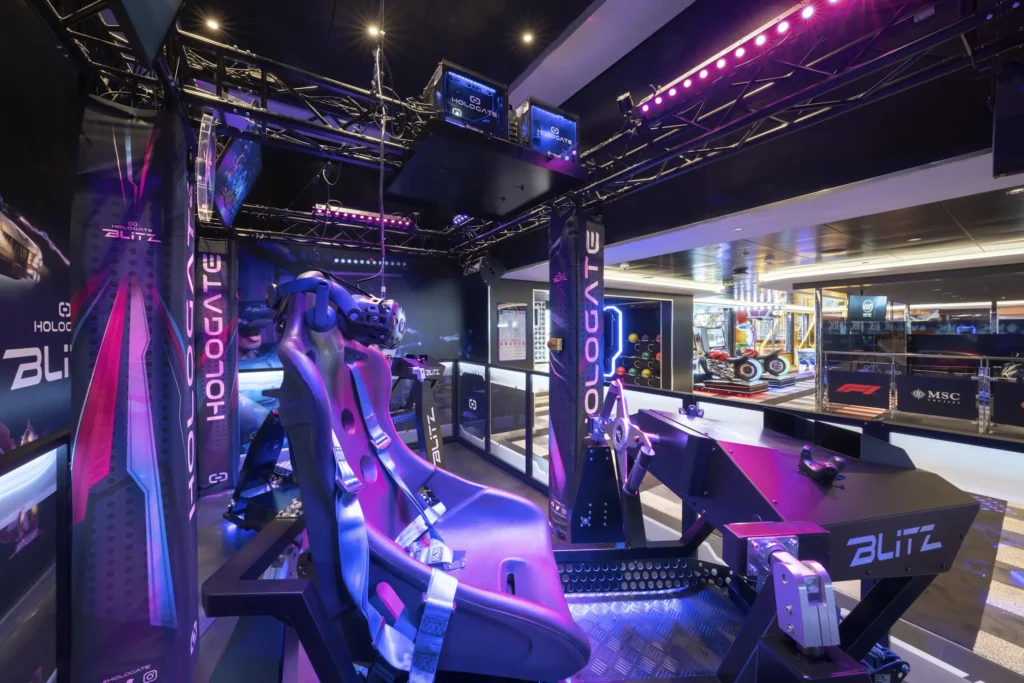
On ships with a more modern amusement setup, you’ll often see VR experiences that go beyond “headset and a chair.” Depending on ship, this can include:
- VR attractions listed as part of the onboard entertainment lineup (some ships list this directly in ship materials)
- Group-based VR arenas such as Hologate experiences, which show up on some ships as an “arena” style attraction (more social, less “solo cockpit”)
Interactive and 4D cinemas (easy win for mixed-age groups)
These are worth explaining clearly because cruisers mix them up all the time:
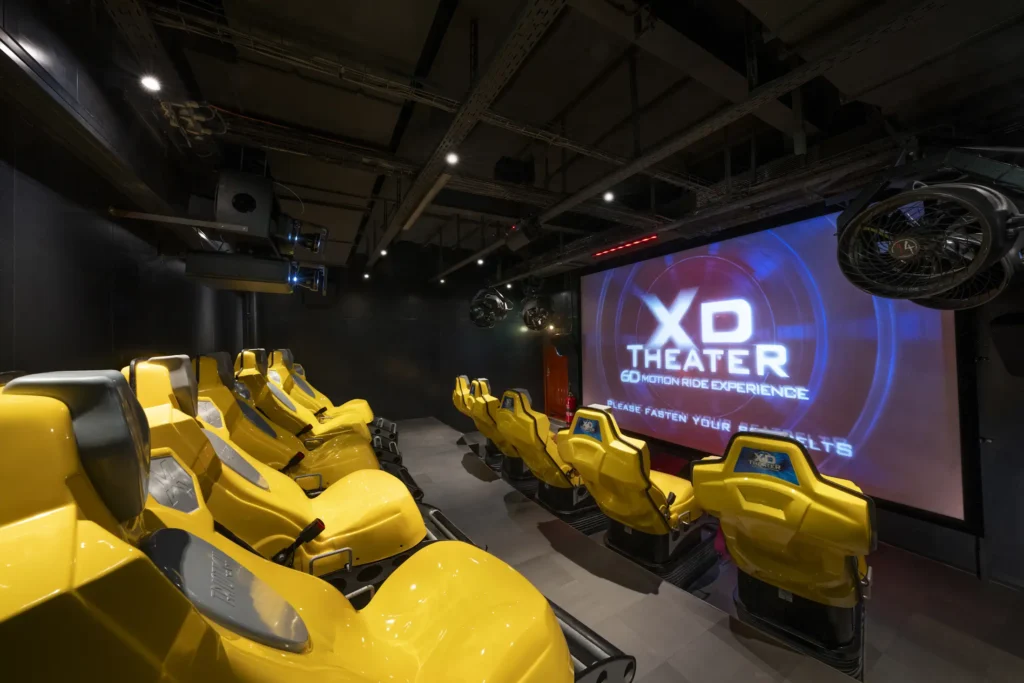
- XD Interactive Cinema: More like a game – you compete for score, usually with a blaster-style controller. MSC lists it among Fun Pass-eligible attractions with a minimum height requirement.
- 4D Cinema: More like a short movie with seat motion and effects (wind, mist, etc.). MSC positions this style of attraction as part of the overall onboard entertainment mix.
The “also in this neighborhood” tech thrills
Some rides and attractions are not VR, but they often get lumped into the same “paid amusement” planning conversation because they live in the same ecosystem.
Example: Robotron on MSC Seascape has published restrictions (age 7+, 4 feet tall, max 298 lbs) and is widely discussed as a marquee paid attraction.
Which MSC ships have VR and simulators?
The simplest practical guidance is this:
- If your ship is on MSC’s Fun Pass ship list, you can generally expect a real Amusement Area lineup, not just a small room of basic arcade cabinets. MSC publishes a list of ships where Fun Pass applies.
- Even within that list, the exact mix varies. Some ships call out specific venues like an arena-style VR attraction, the Formula Racer, and XD interactive cinema in their ship materials (MSC Euribia is one example).
MSCCruiseFan reality check: “VR and simulators” is not a uniform, fleet-wide checklist. It’s more like a sliding scale – the newer and larger the ship, the more likely you are to see multiple premium options.
What does it cost?
MSC’s paid simulator and VR experiences are typically priced per session. The ship will post current pricing onboard, and it can change by sailing and region. The clean way to present this on the page is “typical ranges” plus one or two real examples.
Here are reliable anchor points:
- MSC’s own materials describe the Formula Racer as a paid attraction with pricing that can run up to around $15 per session.
- Third-party ship coverage for MSC Euribia has listed Hologate VR and XD Interactive Cinema at $10 per person as an example of onboard pricing for those attractions (useful as a “here’s what this looks like in the real world” reference).
If you want a simple “what should I budget?” line for readers:
- If your family plans to do multiple premium sessions (racing + VR + cinema), costs add up fast. That’s why the Fun Pass exists.
How the Fun Pass changes the math
Here’s the straight talk: MSC Cruises runs most of this area like a prepaid arcade wallet.
MSC describes Fun Pass like this:
- It’s linked to one guest account, but can be used by the whole family
- When the credit is used up, additional play charges your onboard account
- You can buy it onboard or online before your cruise for online savings
This is the key takeaway you’ll want to emphasize on the page:
Fun Pass is not automatically “worth it.” It’s worth it when you know your group will use it.
A quick rule of thumb you can include:
- If you’re doing one racing session and calling it a day, paying a la carte is usually fine.
- If you have teens (or competitive adults who behave like teens) and you’re planning multiple sessions across a week, Fun Pass is often the only way to keep the per-session cost from feeling painful.
Age, height, and safety restrictions
This is where you want to be helpful and careful.
MSC publishes height requirements for some attractions in official terms, but requirements can still vary by ship and by the specific equipment onboard. MSC also explicitly notes that attractions and availability can vary by ship.
What MSC publishes (good baseline)
- MSC Formula Racer Simulator: minimum height listed as 4’7″ / 140 cm in MSC terms for attractions.
- XD Interactive Cinema: minimum height listed as 3’7-1/4 / 110 cm.
What cruisers experience (why you should verify onboard)
Some cruisers report seeing different height requirements onboard than what they expected from pre-cruise info. The safest advice is:
Treat online requirements as a starting point, then verify on the ship before you buy credits specifically for one child.
MSCCruiseFan tip: If one specific attraction is the entire reason you’re considering Fun Pass, check the signage on Day 1 (or ask the Amusement desk) before committing.
Best times to go so you’re not standing in a line of teenagers
Crowd patterns onboard tend to be predictable:
- Sea days (late morning through afternoon) are peak demand for the Amusement Area.
- The best “quiet window” is often the dinner block when families clear out for the Main Dining Room.
- Port days can be dramatically calmer if you stay onboard.
That last point matters because most of these attractions have limited throughput. A racing simulator is one seat (or a small number of seats). A VR rig is one session at a time. A line forms fast.
MSC vs Royal Caribbean for VR and simulators
This comparison is exactly what your readers want, because it helps them choose a ship that matches their vacation style.
Here’s the simplest way to frame it:
MSC’s philosophy
MSC leans into a digital amusement model: paid sessions for premium experiences like racing simulators, VR attractions, and interactive cinema, managed through onboard charges or Fun Pass credits.
Royal Caribbean’s philosophy
Royal Caribbean International leans harder into big physical signature attractions, many of which are positioned as included activities (especially things like FlowRider in Royal’s own guides).
Royal also features large activity spaces like SeaPlex with roller skating and bumper cars depending on ship, and Royal regularly markets these as part of the onboard activity lineup.
Bottom line
MSC’s VR and simulator scene is fun, modern, and very easy to overspend on if you don’t go in with a plan.
- If your crew loves tech, gaming, racing, and score-chasing, MSC’s paid amusement model can be a big win.
- If you’d rather have more included, physical, active thrills, Royal often feels like the easier “set it and forget it” option.
- Either way, verify restrictions onboard early, pick your best low-crowd windows, and decide whether Fun Pass fits your family’s actual behavior (not your optimistic sea-day fantasy).