
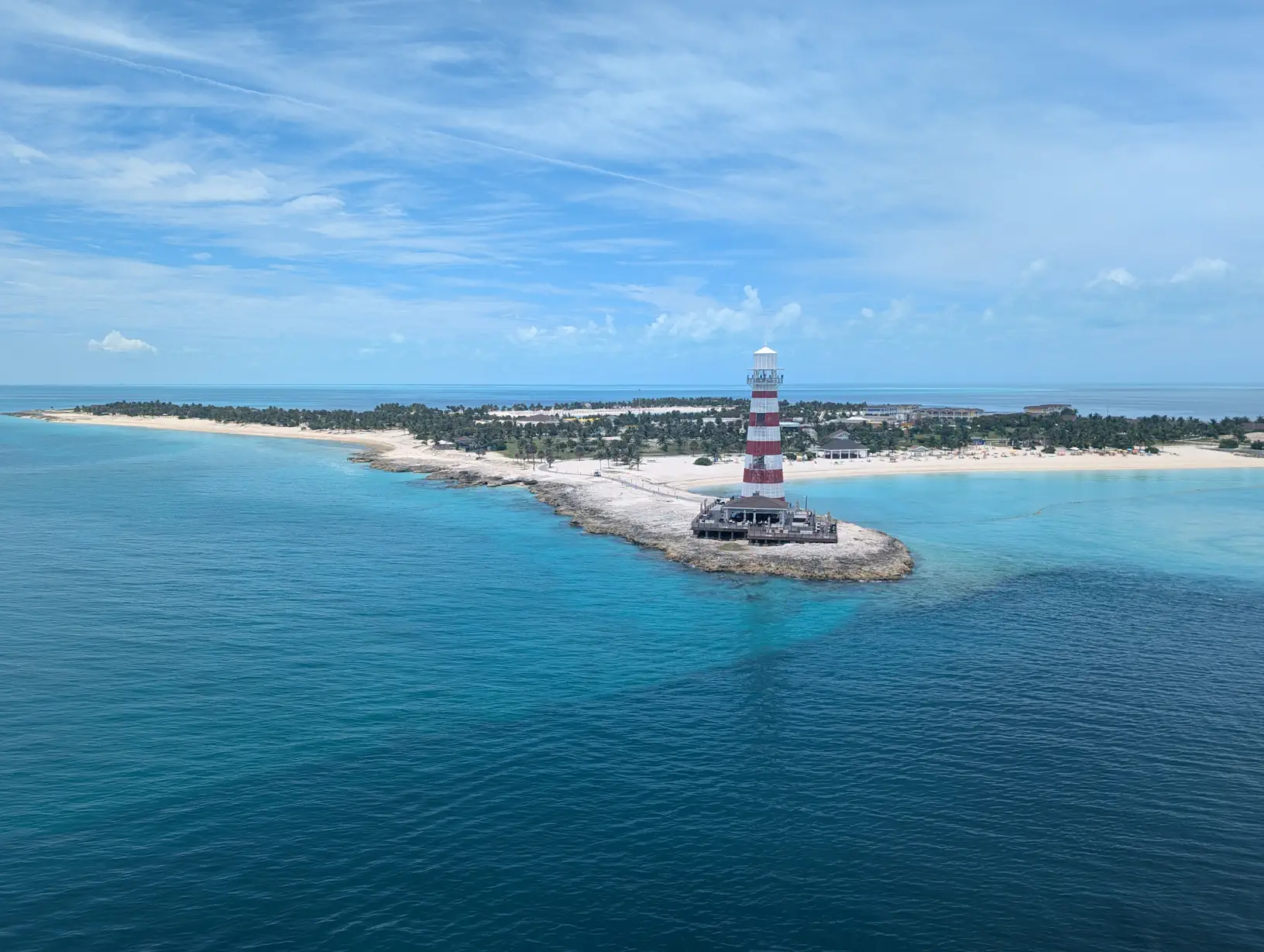
When cruisers talk about private islands, the conversation usually centers on waterparks, beach clubs, and how many frozen drinks you can squeeze into a sea day. Ocean Cay Marine Reserve is different by design.
Yes, it’s MSC’s private island in the Bahamas.
But it’s also a protected marine reserve with a past that looks nothing like the island guests see today.
To understand why Ocean Cay feels so different from other private islands, you have to start with its history – and then look at what MSC Cruises has done to completely rewrite it.
Ocean Cay’s Industrial Past: What the Island Used to Be
Ocean Cay was never a naturally pristine island that MSC simply “claimed.”
Beginning in the late 1960s, the island was leased and used by Dillingham Construction, a U.S.-based firm specializing in dredging and marine construction.
For decades, Ocean Cay functioned as:
- A aragonite sand extraction and processing site. Aragonite sand is the white sand that the Bahamas are known for.
- A staging area for dredging operations throughout the Bahamas and Florida.
- A heavily altered industrial zone rather than a natural island ecosystem.
Sand was mined, processed, and shipped from the island for construction projects across the region. During this time:
- Shorelines were reshaped and eroded
- Coral reefs were damaged or buried
- Native vegetation was largely removed
- Marine biodiversity declined significantly
By the early 2000s, commercial sand mining operations ceased. What remained was an island with limited natural recovery and extensive environmental damage.
MSC Acquires Ocean Cay and Sets a Different Goal
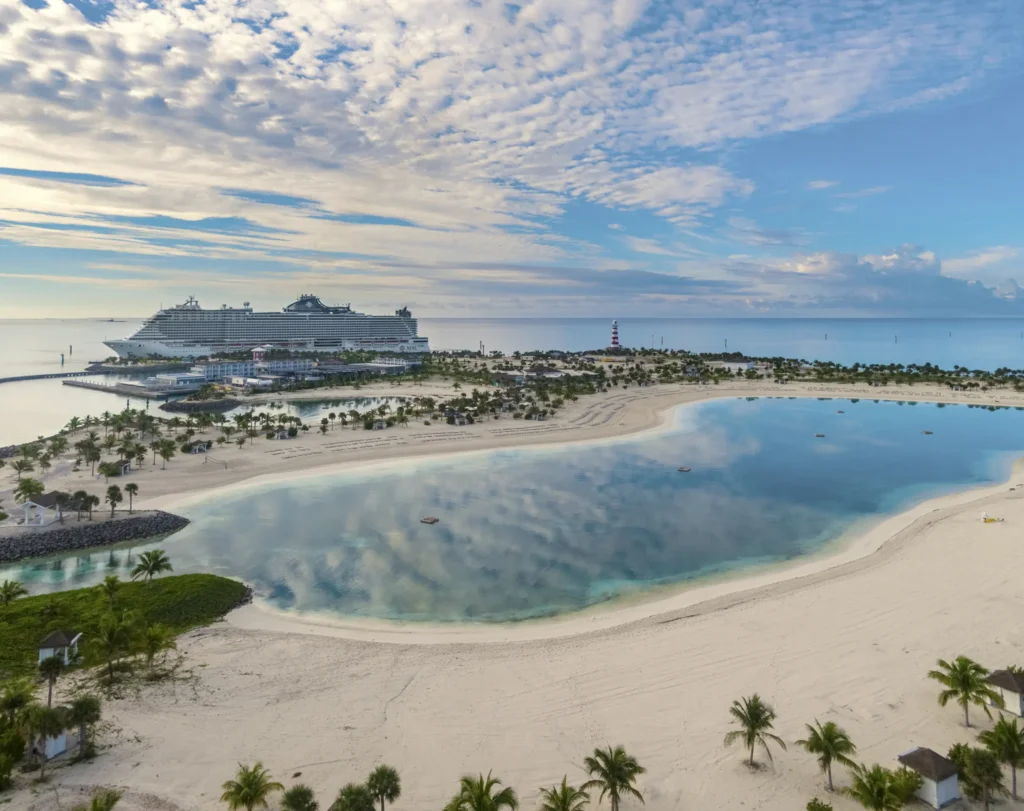
In 2015, MSC Cruises acquired Ocean Cay with a vision that was unusual for the cruise industry. They have a 100 year lease on the island from the Bahamian government. The original investment into Ocean Cay was over $200 million.
Rather than simply building attractions on top of an old industrial site, MSC announced plans to:
- Restore the island’s marine ecosystem
- Rebuild damaged reefs
- Reintroduce native plant life
- Establish the surrounding waters as a protected marine reserve
This was not a quick flip or cosmetic cleanup. The project required:
- Environmental remediation
- Reef reconstruction
- Careful planning to prevent further damage
After several years of restoration work and development, Ocean Cay Marine Reserve officially opened to guests in December 2019.
From Industrial Scar to Marine Reserve
MSC’s approach to Ocean Cay was fundamentally different from traditional private island development.
Instead of maximizing rides, buildings, or density, the focus was on:
- Open beaches
- Natural underwater environments
- Long-term ecological recovery
The island was intentionally designed to feel spacious and less overbuilt, even though it welcomes thousands of guests per week.
This decision directly ties into MSC’s broader sustainability strategy and long-term ocean stewardship goals.
The video below shows the background of the island’s transformation:
What MSC Is Doing for Conservation at Ocean Cay
Coral Reef Restoration
One of MSC’s most visible conservation initiatives at Ocean Cay is coral reef restoration.
MSC established coral nurseries around the island where coral fragments are grown, monitored, and eventually transplanted back onto damaged reef areas. These restored reefs help:
- Rebuild natural reef structures
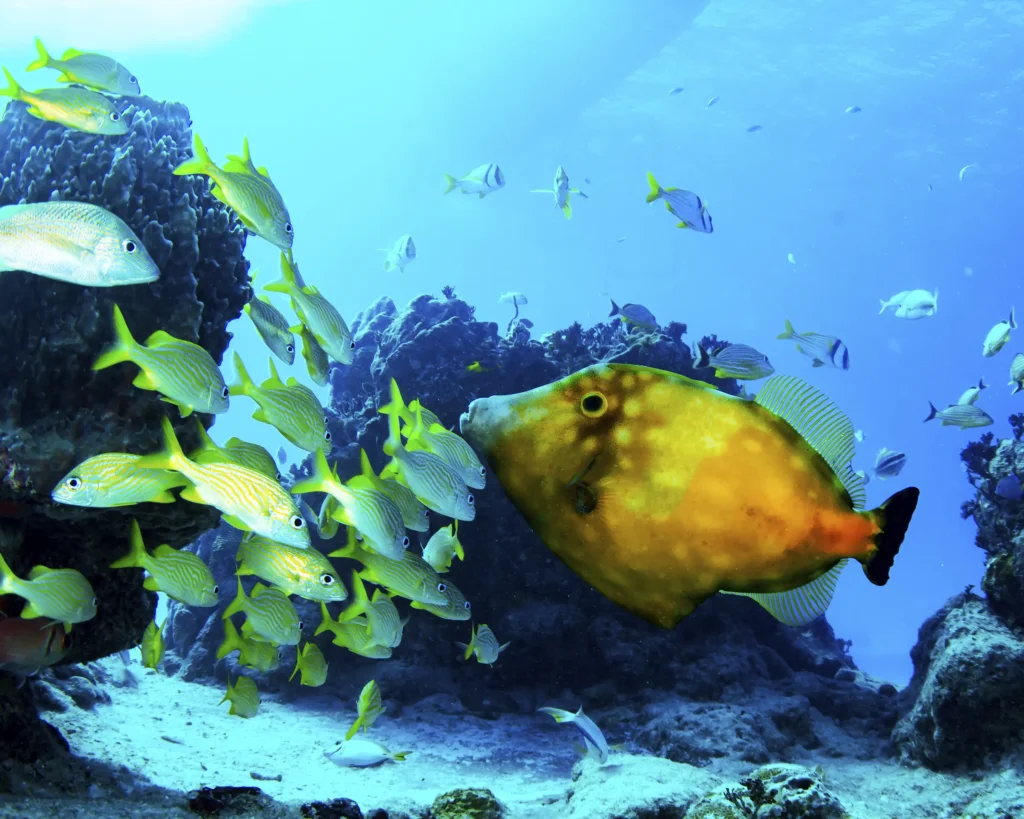
- Support fish populations
- Improve overall water quality
When guests snorkel at Ocean Cay, they’re often swimming over living, recovering reefs, not artificial displays.
Marine Habitat Protection
Ocean Cay is officially designated as a marine reserve, which means:
- Fishing is prohibited
- Coral, shells, and marine life may not be removed
- Snorkeling zones are carefully managed
These protections are critical to preventing the kinds of damage that occurred during the island’s industrial era.
Shoreline and Vegetation Restoration
MSC replanted thousands of native trees, shrubs, and mangroves across the island. This work:
- Reduces erosion
- Stabilizes beaches
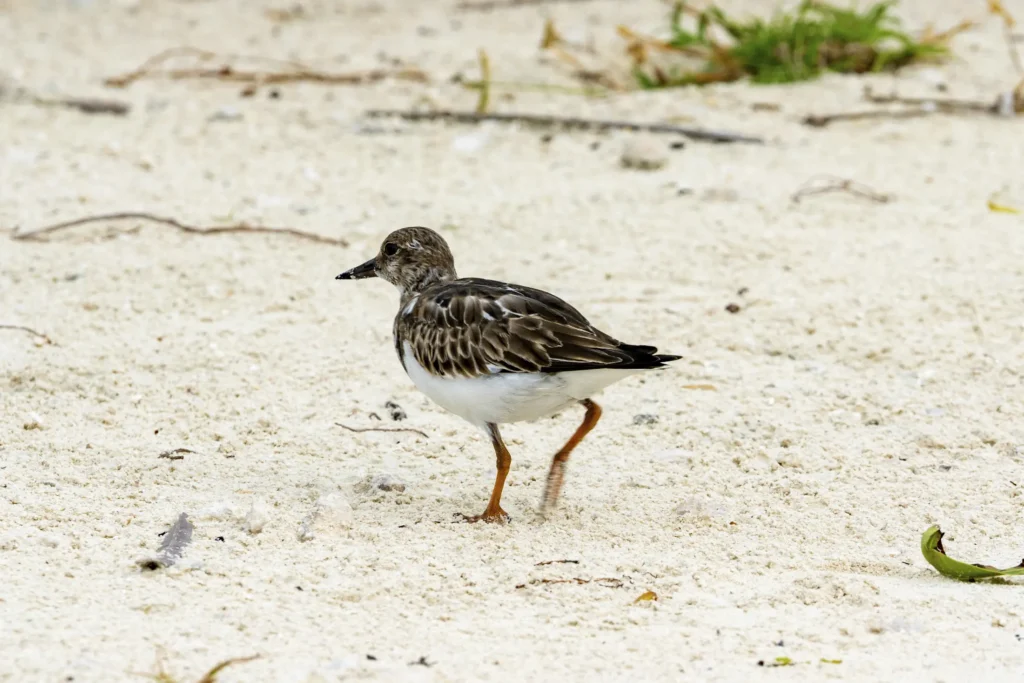
- Supports bird and wildlife habitats
- Improves storm resilience
Large portions of the island are intentionally left undeveloped to allow natural systems to recover.
Sustainable Infrastructure Choices
Even behind the scenes, Ocean Cay was built with sustainability in mind:
- LED lighting throughout the island, including the lighthouse
- Improved waste management systems
- Reduced reliance on single-use plastics
The island’s infrastructure balances guest experience with environmental responsibility.
What Being a Marine Reserve Means for Guests
Despite the protections in place, Ocean Cay does not feel restrictive.
Guests can still:
- Swim and snorkel freely
- Relax on expansive beaches
- Enjoy food, drinks, and cabanas
- Explore the island on foot
What you won’t find are high-impact activities that threaten reef systems or wildlife habitats.
The result is an island that feels calmer and more natural than many private cruise destinations.
Why Ocean Cay Feels Different Today
Ocean Cay isn’t trying to compete with waterpark-style private islands.
Its identity is shaped by its industrial past, its environmental recovery and MSC’s decision to prioritize restoration over spectacle
That history is exactly why the island feels more open, less crowded, and more authentic.
The MSC Super Coral Program: Protecting Our Reefs
The Super Coral Program is the flagship environmental initiative of the MSC Foundation, officially launched in 2019 to restore the 64-square-mile marine ecosystem surrounding Ocean Cay. While the island’s restoration began in 2015, the program entered a critical scientific phase in 2020 through partnerships with the University of Miami and Nova Southeastern University. The initiative focuses on “thermal-resilient” corals—specifically the critically endangered Elkhorn coral—identifying hardy genotypes that can survive rising ocean temperatures. This research proved its value in 2023 when the program’s nursery corals achieved a remarkable 100% survival rate during a global marine heatwave. With the grand opening of the Marine Conservation Center in April 2025, the program has scaled up significantly. Today, fans visiting the island can explore “The Aquaria,” a land-based nursery with 22 specialized tanks, and learn how the foundation aims to outplant 6,000 corals annually. This transition from a former industrial sand-mining site to a Mission Blue “Hope Spot” makes Ocean Cay a unique destination where vacationing meets vital marine science.
The Future of Ocean Cay
The future of the Ocean Cay MSC Marine Reserve is focused on a dual commitment to ecological restoration and enhanced guest immersion, highlighted by the 2025 opening of a state-of-the-art Marine Conservation Center. This facility serves as the hub for the “Super Coral” program, which aims to outplant 6,000 heat-resistant corals annually to future-proof the surrounding reefs against climate change. Looking into 2026 and 2027, the island is undergoing a significant “phase two” expansion that includes the development of Little Cay—a secondary retreat for Yacht Club and Explora Journeys guests—and the introduction of augmented-reality (AR) educational trails and expanded wellness programming. MSC is positioning Ocean Cay as a global model for sustainable tourism where industrial rehabilitation meets active marine science.
The Bottom Line
Ocean Cay’s story is one of transformation.
From a heavily altered industrial sand-mining site in the 1960s and 70s, to a protected marine reserve opened in 2019, MSC has turned Ocean Cay into a recovering ecosystem, a working example of marine restoration and a private island that puts conservation at the center of the experience
For cruisers, that means a port stop that feels intentionally different.
For MSC, it represents a long-term commitment to protecting the oceans cruising depends on.